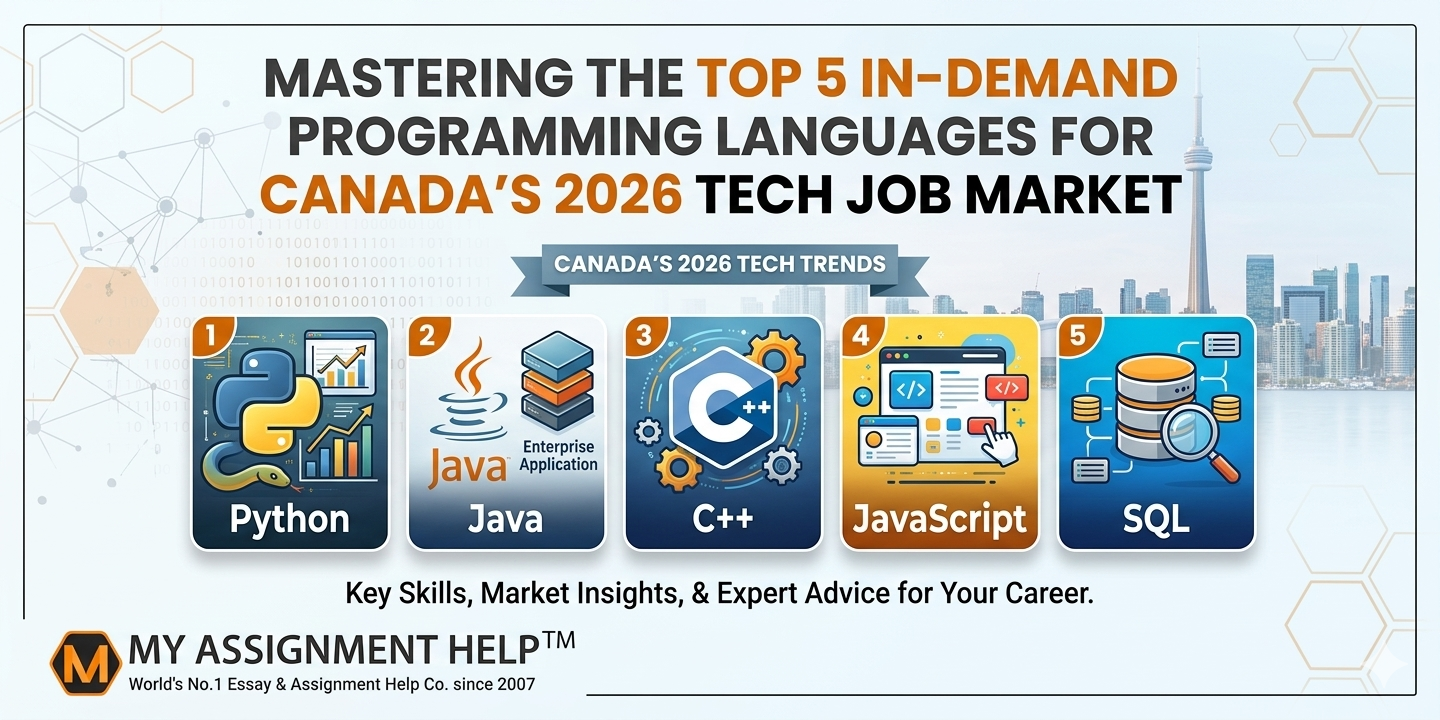
The Canadian tech landscape in 2026 is no longer just a “northern hub” for Silicon Valley; it has evolved into a self-sustaining powerhouse. With the rapid expansion of AI research in Montreal, fintech growth in Toronto, and Vancouver’s burgeoning SaaS ecosystem, the demand for specialized developers has reached a fever pitch.
However, the “Great Tech Shift” of the mid-2020s has changed what employers are looking for. It is no longer enough to simply “know how to code.” Success in the 2026 market requires a blend of algorithmic efficiency, cloud-native architecture, and the ability to integrate AI-driven workflows. For students and career-switchers navigating these high stakes, the pressure to master complex syntax while maintaining academic performance can be overwhelming. Many are turning to professional programming homework help to bridge the gap between theoretical classroom concepts and the rigorous coding standards required by Canadian tech giants like Shopify, Constellation Software, and OpenText.
This guide breaks down the five most critical languages you need to master to stay competitive in Canada’s current economic climate, backed by labor market data and industry trends.
The 2026 Language Hierarchy: Data-Driven Insights
According to recent labor market reports from the Information and Communications Technology Council (ICTC) and Statistics Canada, specialized tech roles are expected to see a 12% growth rate through the end of 2026.
1. Python: The Backbone of the AI Revolution
Python remains the undisputed king of the Canadian tech market. In 2026, its dominance is fueled by Canada’s $2.1 billion federal investment in AI computing sovereign capacity. From the Vector Institute to Mila, Python is the primary language for machine learning (ML) and data science.
- Why it’s in demand: It is the “glue” language for AI integration. If you are working on LLM fine-tuning or predictive analytics for a Bay Street financial firm, Python is your primary tool.
- Key Frameworks: PyTorch, TensorFlow, and FastAPI.
2. JavaScript / TypeScript: The Full-Stack Standard
While JavaScript built the web, TypeScript has secured it. Most Canadian enterprise-level startups now mandate TypeScript for its static typing, which reduces runtime errors in large-scale applications.
- Why it’s in demand: With the rise of “Super Apps” in the Canadian retail sector, the need for seamless, responsive front-ends and robust Node.js back-ends is at an all-time high.
- Key Frameworks: Next.js, React, and NestJS.
3. Java: The Enterprise Workhorse
Despite the “trendiness” of newer languages, Java remains the foundation of Canada’s banking and insurance sectors. RBC, TD, and Scotiabank rely on Java for their legacy systems and modern microservices alike.
If you are struggling with the complexities of object-oriented programming (OOP) or multi-threading in your curriculum, utilizing expert assignment writing services can help you understand how these concepts are applied in high-security financial environments.
- Why it’s in demand: High-performance, scalable back-ends for the fintech and healthcare sectors.
- Key Frameworks: Spring Boot 3.x, Quarkus.
4. Rust: The Safety Pioneer
Rust has seen a meteoric rise in 2026, particularly in Vancouver’s systems programming and gaming scenes. Known for its memory safety without a garbage collector, it is replacing C++ in performance-critical applications.
- Why it’s in demand: As cybersecurity threats become more sophisticated, Canadian firms are prioritizing Rust to build “memory-safe” infrastructure.
5. Go (Golang): The Cloud-Native Choice
As Canadian companies move toward multi-cloud strategies using AWS (with regions in Calgary and Montreal) and Azure, Go has become the language of choice for cloud infrastructure and DevOps tooling.
- Why it’s in demand: Its simplicity and efficiency in handling concurrent tasks make it perfect for the microservices that power Canada’s logistics and supply chain tech.
See also: Basement Home Theater Setup Inspirations
Key Takeaways for Success in 2026
- Focus on Ecosystems, Not Just Syntax: Employers value your knowledge of frameworks (like Next.js or Spring Boot) as much as the language itself.
- AI-Assisted Coding: Mastery of GitHub Copilot and other AI agents is now a prerequisite in 85% of Canadian junior developer job postings.
- Localize Your Portfolio: Showcase projects that solve Canadian problems—such as carbon tax tracking apps or bilingual (English/French) CMS platforms.
Frequently Asked Questions (FAQ)
Q1: Is a Computer Science degree enough to get a job in Canada in 2026?
While a degree provides the foundation, the 2026 market demands a portfolio. Employers look for Git contributions, cloud certifications (AWS/Azure), and evidence of problem-solving in real-world scenarios.
Q2: How important is bilingualism (English/French) for tech roles?
In Quebec, it is essential. For the rest of Canada, it is a significant “soft skill” advantage, especially for companies with offices in Montreal or those serving federal government contracts.
Q3: Which language pays the highest salary for entry-level roles?
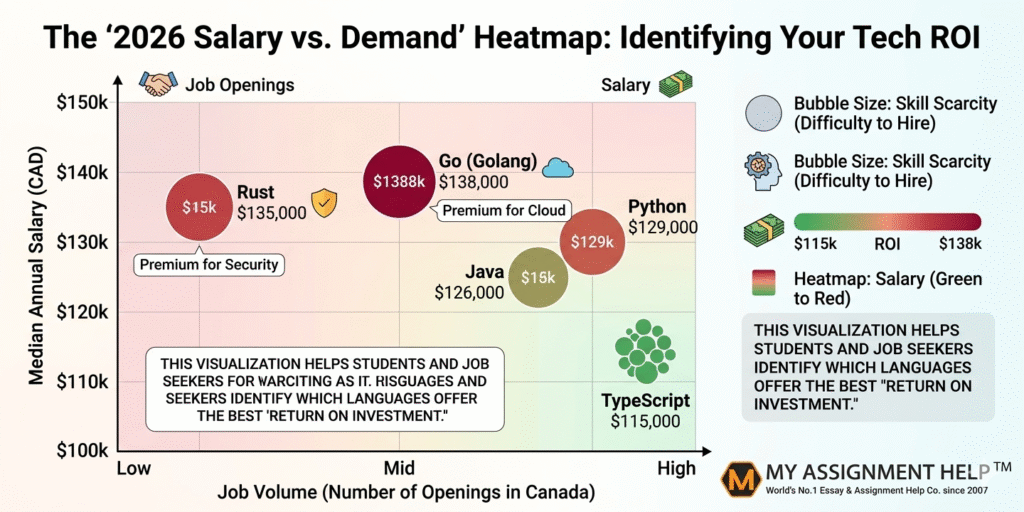
Currently, Rust and Go command the highest entry-level salaries in Canada due to a shortage of skilled developers compared to the high demand in systems and cloud engineering.
References & Data Sources
- ICTC (Information and Communications Technology Council): 2024-2027 Digital Talent Outlook for Canada.
- Statistics Canada: Labour Force Survey, Tech Sector Analysis 2025-2026.
- The Globe and Mail (Report on Business): The Impact of Sovereign AI on Canada’s Tech Job Market.
- Stack Overflow Developer Survey (2025/2026): Language Popularity and Salary Trends.
About the Author
Angelika S. is a Senior Content Strategist and Academic Consultant at MyAssignmentHelp. With over eight years of experience in the EdTech sector, she specializes in aligning academic curricula with the evolving demands of the global tech industry. Having helped thousands of students navigate the complexities of Canadian educational standards (from UofT to UBC), Angelika focuses on providing data-driven insights that empower the next generation of developers. Her work emphasizes the bridge between theoretical coding and industry-grade software engineering.