AI applications in space research are transforming methodologies across various domains. By employing machine learning algorithms, scientists can analyze extensive astronomical datasets with improved accuracy. Additionally, these technologies enhance spacecraft navigation and enable autonomous exploration of planetary surfaces. As predictive maintenance strategies advance, the reliability of space missions increases. However, the implications of these advancements extend beyond operational efficiency, raising questions about their impact on future discoveries and the search for extraterrestrial life.
Harnessing AI for Data Analysis in Astronomy
In recent years, a significant number of astronomical datasets have been generated, necessitating advanced analytical techniques for effective interpretation.
The integration of artificial intelligence has revolutionized the analysis of stellar data, enabling precise celestial mapping. Algorithms can efficiently process vast quantities of information, uncovering patterns and anomalies that enhance our understanding of the universe, while promoting greater autonomy in data-driven astronomical research.
Enhancing Spacecraft Navigation With Machine Learning
As spacecraft navigate the complexities of space travel, the application of machine learning technologies has emerged as a crucial advancement in enhancing navigation systems.
Adaptive algorithms improve decision-making processes by analyzing real-time data, while sensor fusion enables the integration of multiple data sources.
This combination allows for more accurate positioning and maneuvering, ultimately increasing mission success rates and ensuring safer exploration of the cosmos.
AI-Driven Innovations in Planetary Exploration
While planetary exploration presents unique challenges, AI-driven innovations have significantly transformed the methodologies employed in analyzing extraterrestrial environments.
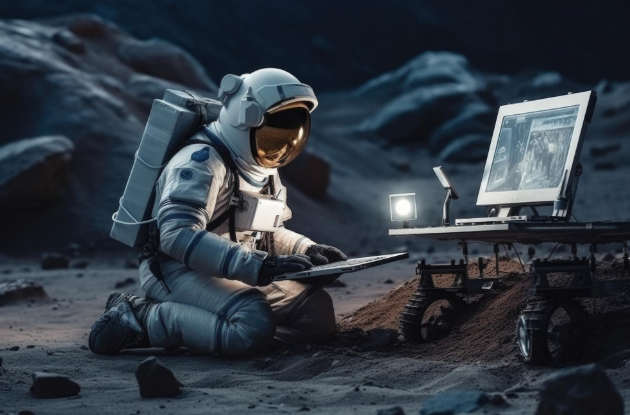
Robotic rovers equipped with advanced AI algorithms now autonomously navigate rugged terrains, optimizing data collection processes.
Furthermore, satellite imaging enhanced by machine learning techniques enables precise mapping and analysis of planetary surfaces, facilitating a deeper understanding of celestial bodies and their potential for supporting life.
See also: allherejob
Predictive Maintenance and Autonomous Systems in Space Missions
Predictive maintenance plays a critical role in enhancing the reliability and efficiency of autonomous systems used in space missions.
By leveraging predictive analytics, engineers can develop maintenance strategies that anticipate equipment failures before they occur. This proactive approach minimizes downtime, optimizes resource allocation, and ensures mission success.
As space exploration advances, the integration of these technologies becomes essential for sustaining long-duration missions in challenging environments.
Conclusion
The integration of AI in space research not only streamlines operations but also coincides with a profound shift in our understanding of the cosmos. As machine learning algorithms enhance data analysis and navigation, researchers simultaneously uncover unexpected patterns and phenomena, revealing the universe’s complexities. This synergy of advanced technology and scientific inquiry fosters a richer exploration of extraterrestrial environments, ultimately leading to groundbreaking insights about the potential for life beyond Earth and the broader implications for humanity’s place in the universe.