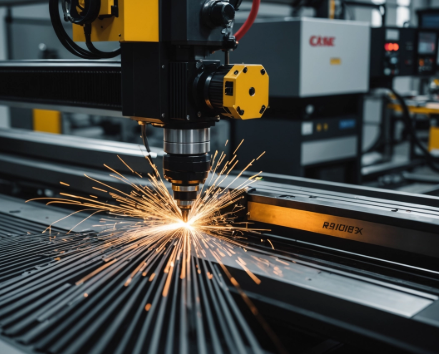
Metal tubes and pipes are essential components in construction, automotive manufacturing, furniture production, and industrial equipment. Processing these materials accurately is important for creating strong joints, consistent dimensions, and professional finishes. A metal tube laser cutting machine uses focused laser energy and computer-controlled movements to cut tubes into precise shapes, openings, and lengths. This technology helps manufacturers streamline fabrication, reduce manual operations, and produce customized metal components more efficiently.
What Is a Metal Tube Laser Cutting Machine?
A metal tube laser cutting machine is an industrial system designed to process hollow metal profiles using a concentrated laser beam. The tube is secured by a clamping mechanism and positioned or rotated while the cutting head follows a programmed path. The laser heats and melts the material, while assist gas removes molten metal from the cutting area.
Modern machines commonly use computer numerical control (CNC) systems to execute digital designs. Depending on the equipment configuration, they can process round, square, rectangular, and certain specialized profiles. Some models also support automated feeding and unloading, helping manufacturers reduce repeated manual handling.
Material compatibility and cutting capacity depend on laser power, tube dimensions, wall thickness, and the machine’s clamping and motion systems. Steel, stainless steel, and aluminum tubing are among the materials commonly processed with suitable equipment.
Key Benefits of Laser Tube Cutting
1. Accurate and Consistent Cuts
Precision is essential when tubes must connect with other components or fit into welded assemblies. Laser cutting can create accurate openings, slots, angled ends, and complex contours. CNC programming also helps maintain consistency when producing repeated parts.
2. Faster Fabrication
Traditional tube processing may require separate sawing, drilling, milling, and marking operations. A suitable laser tube cutting system can combine several of these tasks within one programmed workflow, reducing material handling and production delays.
The actual time savings depend on component design, production volume, machine configuration, and the complexity of the required cuts.
3. Reduced Material Waste
Accurate cutting and optimized production layouts can help manufacturers use raw materials more efficiently. Software can organize cutting operations to reduce unnecessary offcuts, while precise dimensions may also reduce errors caused by manual measurement.
4. Greater Design Flexibility
Manufacturers frequently need different hole patterns, lengths, and connection shapes for customized products. CNC-based laser cutting makes it possible to change designs through programming rather than manufacturing dedicated mechanical tooling for every variation.
This flexibility is particularly useful for prototype development, custom orders, and production facilities handling multiple product types.
5. Improved Production Automation
Depending on the model, automatic tube feeding, chuck positioning, and unloading systems can reduce repetitive manual work. These features may improve production consistency and help businesses manage larger orders with more predictable workflows.
Industries That Use Metal Tube Laser Cutting Machines
Tube laser cutting supports a wide range of manufacturing applications.
Furniture manufacturing: Metal tubes are used in chairs, tables, shelving, bed frames, display stands, and office furniture. Laser cutting can create connection holes and precisely shaped ends that simplify assembly.
Construction and structural fabrication: Steel tubes and hollow profiles are widely used in support frames, railings, trusses, and structural assemblies. Accurate cutting helps prepare components for welding and installation.
Automotive manufacturing: Tube components appear in vehicle structures, support brackets, protective frames, and selected exhaust-related assemblies. Consistent processing helps manufacturers meet design specifications.
Fitness equipment: Exercise machines, gym frames, and training equipment often use tubular steel components that require precise openings and repeatable dimensions.
Agricultural machinery: Manufacturers use tube cutting to produce machine frames, protective structures, brackets, and other fabricated parts.
Industrial equipment: Machinery guards, equipment supports, conveyor structures, and customized metal frameworks can benefit from accurately processed tubing.
How to Choose the Right Machine
Selecting the appropriate system begins with understanding your production requirements.
Tube shape and dimensions: Determine whether you primarily process round, square, rectangular, or specialized profiles. Confirm the maximum diameter, side dimensions, length, and weight that the machine can accommodate.
Material and wall thickness: Identify the metals you use and their typical wall thicknesses. Request cutting specifications for your actual materials rather than relying only on advertised laser power.
Laser power: Higher power may increase cutting capacity or speed for suitable applications, but it can also raise purchase and operating costs. Select a power level that matches your regular workload.
Automation requirements: Consider whether manual loading is sufficient or whether automatic feeding and unloading could improve productivity.
Software and support: Evaluate CNC controls, programming compatibility, operator training, warranty coverage, spare parts, and after-sales technical assistance.
HS Laser offers industrial laser equipment for metal-processing applications. Businesses exploring its cutting machine range should confirm the appropriate tube-cutting configuration, available models, technical specifications, and sample cutting performance directly with the supplier.
Maintenance and Safety Practices
Regular maintenance helps keep tube laser cutting equipment operating reliably. Operators should inspect cutting nozzles, protective lenses, cooling systems, clamps, and moving components according to the manufacturer’s instructions. Proper tube alignment and secure clamping are also important for cutting accuracy.
Laser equipment requires suitable safety controls, which may include protective enclosures, interlocks, warning indicators, appropriate protective eyewear, and effective extraction for fumes and airborne particles. Operators should receive proper training and follow all manufacturer procedures.
Conclusion
A metal tube laser cutting machine offers manufacturers an efficient method for producing accurately shaped tubes and profiles. Its combination of CNC control, design flexibility, and automation can simplify fabrication across furniture, construction, automotive, fitness, and industrial applications. By assessing tube dimensions, material thickness, laser power, production volume, and supplier support, businesses can select equipment that meets their requirements and supports long-term manufacturing efficiency.